



Cyber Insurance
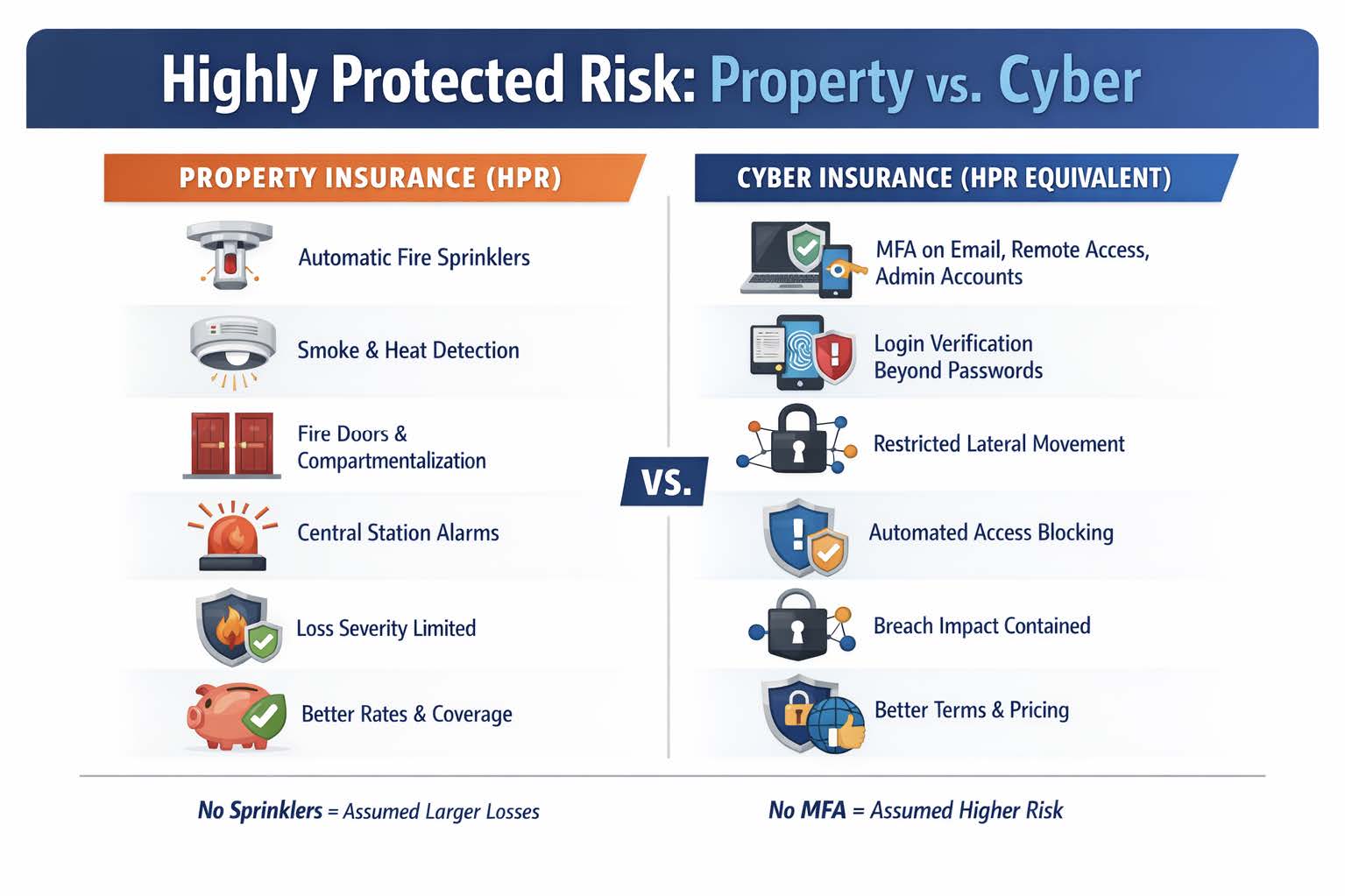
In property insurance, everyone understands the concept of a Highly Protected Risk (HPR). It is the building with sprinklers, alarms, fire doors—and fewer uncomfortable conversations after a loss. Those protections don't eliminate risk, but they dramatically change the likelihood and severity of an event.
Cyber insurance has quietly reached the same place. Multi-Factor Authentication (MFA) has become one of the clearest indicators that a company qualifies as a highly protected cyber risk.
Cyber insurers have learned—sometimes expensively—that most losses do not come from brilliant hackers or cutting-edge malware. They come from phishing emails, reused passwords, and logins that never should have worked. That is not a sophisticated attack. It is leaving the door unlocked.

MFA Is the Cyber Sprinkler System
From an underwriting standpoint, MFA serves the same purpose as a sprinkler system. It activates automatically, does not rely on perfect human behavior, and helps limit damage before anyone has time to react. It turns a single stolen password into an inconvenience instead of a catastrophe.
An account with MFA looks like a sprinklered building: layered protection, consistent controls, and fewer opportunities for a small issue to turn into a major loss.
An account without MFA? That looks more like a wooden structure full of cardboard. One spark is all it takes.
Why MFA Matters So Much to Insurers
Cyber insurers track loss trends closely, and time after time, MFA shows up as one of the most effective controls for reducing both the frequency and size of claims. It disrupts the credential-based attacks, which make up a large share of incidents. It also signals that the organization is capable of maintaining basic cyber hygiene, which plays a significant role in underwriting decisions.
MFA doesn't solve every problem, but it removes an entire category of easy wins for attackers—and those easy wins are responsible for a surprising number of high-severity losses.
How MFA Changes Insurance Terms
When MFA is properly implemented, insurers are far more likely to treat the account as a highly protected cyber risk. This can lead to:
- Broader ransomware coverage
- Higher social engineering sublimits
- Fewer restrictive exclusions
- More favorable pricing
- Less pushback during renewal
Without MFA, insurers respond the same way they do to non-sprinklered properties—the terms are rarely generous, and the conversation often starts with what coverage won't be available.
 Where Insurers Expect MFA
Cyber underwriters generally expect MFA in the areas with the highest concentration of loss activity:
- Email systems (Microsoft 365, Google Workspace, etc.)
- Remote access (VPN, remote desktop, remote management tools)
- Administrator accounts (domain admins, cloud admins, and privileged roles)
These controls don't need to be complicated, but they do need to be consistent. Even a single unprotected remote access path can undermine an otherwise solid security program.
MFA as a Strategic Business DecisionFor many organizations, MFA has shifted from a security decision to a business continuity decision. It helps maintain uptime, limits operational disruption during security events, and strengthens a company's negotiating positions with insurers and vendors.
In other words, MFA isn't just an IT control. It's part of the organization's overall risk posture—and increasingly, part of how companies protect their balance sheets.
Bottom Line
Just as sprinklers and alarms define a Highly Protected Risk in property insurance, MFA now defines a highly protected cyber risk. It's inexpensive, easy to deploy, and dramatically reduces loss severity—which is exactly why cyber insurers reward companies that have it in place.
A building without sprinklers raises eyebrows. A cyber environment without MFA does the same.
This article is not intended to be exhaustive, nor should any discussion or opinions be construed as legal advice. Readers should contact legal counsel or an insurance professional for appropriate advice.
About the Author

Insights
- Retail Brokers vs Wholesale Brokers: What Insurance Agents Need to Know
- MGA and Wholesale Insurance Broker: Understanding the Difference (and the Overlap)
- Wholesale Insurance for the Construction Industry: A Guide for Retail Agents
- Distributor Insurance: Understanding Coverage Needs in a Shifting Supply Chain Landscape
- Equine Mortality Insurance: What Retail Agents Should Know
- Excess Flood Insurance: What Agents Should Know
- Wind Deductible Buy Backs: What Retail Agents Should Know
- EIFS Insurance: What Agents Should Know
- Navigating Professional Liability in the Healthcare Space: What Retail Brokers Need to Know
- Insurance for Renewable Energy Projects: What You Need to Know
- What is an Umbrella Insurance Policy?
- What is Animal Mortality Insurance?

.png)
.png)
